Office of the President
President of the Republic of Kenya, C.G.H. · Sworn in 13 September 2022
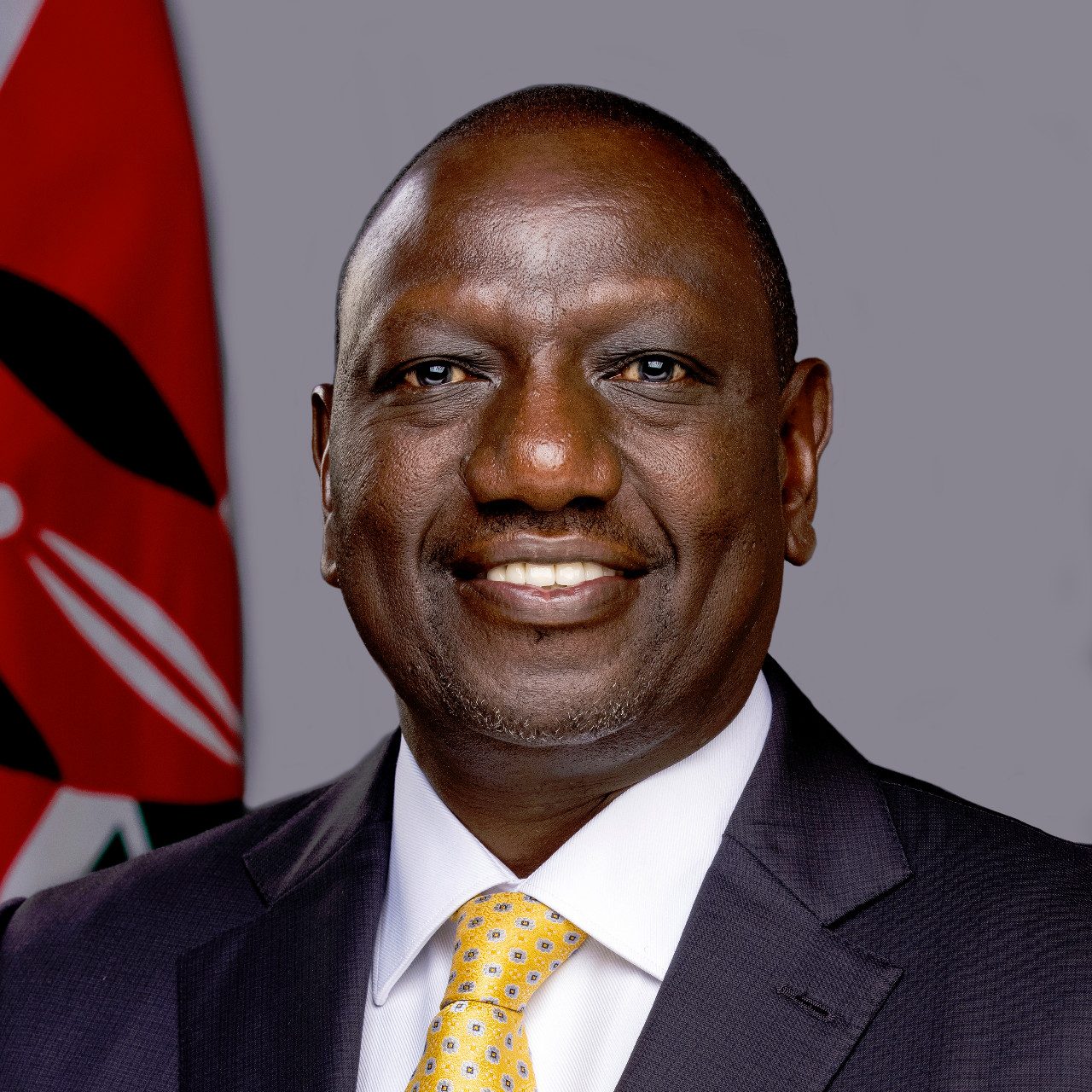
H.E. Dr. William Samoei Ruto
The President is the Head of State and Government, Commander-in-Chief of the Defence Forces, and the symbol of national unity. The office exercises the executive authority of the Republic in accordance with the Constitution.
President of the Republic of Kenya, C.G.H. · Sworn in 13 September 2022
Biography
Dr. William Samoei Ruto was sworn in as President on 13 September 2022, after winning the presidential election held on 9 August 2022 on the United Democratic Alliance (UDA) ticket within the Kenya Kwanza Alliance. He previously served as Deputy President from 3 April 2013 to 12 September 2022.
Political career
- First elected Member of Parliament for Eldoret North on the KANU ticket, serving three terms (1997–2013).
- Elected KANU Secretary General in 2005.
- Chaired the Parliamentary Select Committee on Constitutional Reform in the 9th Parliament, facilitating Kenya's constitutional reform process.
- Minister for Agriculture (2008–2011), overseeing revitalisation of irrigation and affordable fertilizer provision.
- Minister of Higher Education, focusing on knowledge acquisition and skills policy.
- Worked with President Uhuru Kenyatta to form the Jubilee Alliance in 2012, combining URP and TNA, winning the 2013 and 2017 elections.
Early life & education
- Born 21 December 1966 in Sambut, Kamagut Location, Uasin Gishu County.
- Educated at Sambut Primary School, Wareng Secondary School (Eldoret) and Kapsabet High School (Nandi County).
- Studied Botany and Zoology at the University of Nairobi.
- Master of Science in Plant Ecology (2008) and PhD in Plant Ecology (December 2018), University of Nairobi.
Policy platform
President Ruto campaigned on a platform of economic transformation and inclusivity for the everyday Kenyan, achieving a first-attempt presidential victory.
Constitutional mandate
The President exercises executive authority with the assistance of the Deputy President and Cabinet Secretaries. The office safeguards the sovereignty of the Republic, promotes and enhances the unity of the nation, and ensures the protection of human rights and fundamental freedoms and the rule of law.
Key functions
- Providing leadership in the national interest and in accordance with the Constitution.
- Assenting to and signing bills passed by Parliament into law.
- Nominating and appointing Cabinet Secretaries and other State officers.
- Directing and coordinating the functions of ministries and government departments.
- Representing the Republic in its international relations.
Commander-in-Chief
As Commander-in-Chief of the Defence Forces, the President chairs the National Security Council and bears ultimate responsibility for the security of the nation and its people.